Lazy Eye Treatment for Adults: What the Evidence Really Says About Amblyopia After Childhood
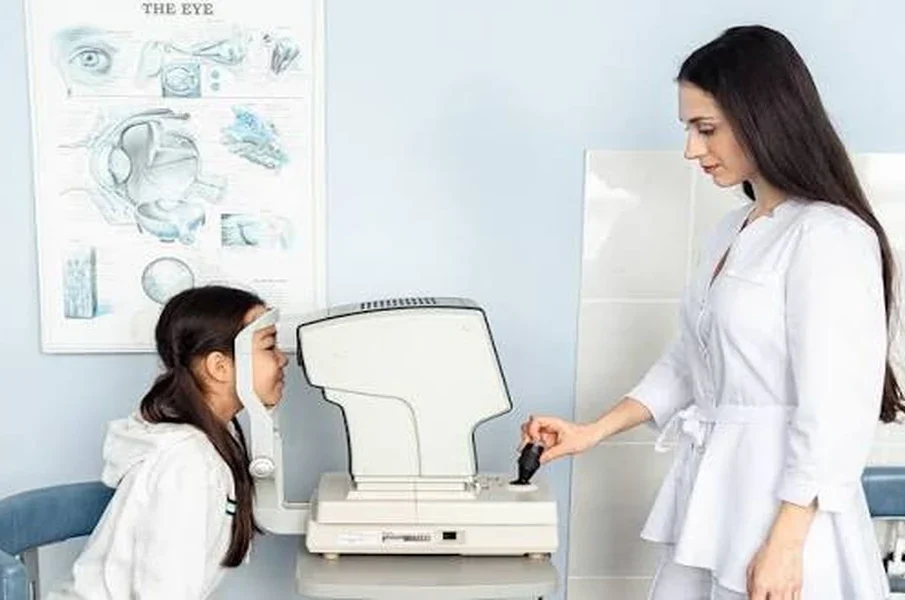
“I was told as a child that nothing could be done after age eight. Is that still true?” Research over the last fifteen years has softened that message considerably. The adult brain is less plastic than a child’s, but it is not fixed, and a proportion of adults do gain measurable vision with the right programme. This article sets out what amblyopia is, which treatments have evidence in adults, what results are realistic, and when surgery has a role.
What amblyopia is (and is not)
Amblyopia, commonly called lazy eye, is reduced vision in an eye that is structurally healthy. During early childhood the brain learned to suppress a blurry or misaligned image from that eye and never developed normal processing for it. The usual causes are:
- Refractive amblyopia: a large difference in power between the two eyes, or very high power in both, that went uncorrected.
- Strabismic amblyopia: a squint, where the turned eye is suppressed to avoid double vision.
- Deprivation amblyopia: something blocked vision early on, such as a congenital cataract or droopy eyelid.
The problem is in the visual cortex, not the eyeball. That is why a lazy eye cannot be “fixed” by stronger glasses alone or by cosmetic squint surgery alone, and why treatment aims at retraining the brain.
Why adults were told it was too late
The “critical period” for visual development runs to roughly age seven to nine. Older patching studies showed the biggest gains in young children, and treatment was simply not offered beyond the mid-teens on the assumption that the cortex loses all plasticity after that.
That assumption has been tested and found to be too pessimistic. Several lines of evidence now show residual plasticity in adults:
- Adults who lose vision in their good eye (through injury or disease) sometimes experience spontaneous improvement in the amblyopic eye, proving the pathway can still change.
- Controlled trials of perceptual learning and binocular (dichoptic) training have produced improvements of one to two lines on the vision chart in a meaningful share of adult participants.
- Combined approaches (optical correction plus training) tend to outperform patching alone in adults.
Treatments with evidence in adults
1. Full and accurate optical correction
The first step is often overlooked. Many adults have never worn the full prescription for the amblyopic eye because it “did not help”. Wearing the correct glasses or contact lenses continuously for 12 to 18 weeks, before any other treatment, improves vision on its own in some adults and is a prerequisite for everything else. A detailed personalised eye examination with cycloplegic refraction establishes the true power.
2. Patching or atropine penalisation
Covering the good eye for two to six hours a day forces the weaker eye to work. In adults, patching produces smaller and slower gains than in children, and compliance is a challenge for anyone who drives or works on screens. It is still used, usually combined with active tasks rather than passive wearing.
3. Perceptual learning and vision therapy
Structured, repetitive visual tasks performed with the amblyopic eye (contrast detection, letter and position discrimination, eye-tracking exercises) over several weeks. Gains are task-specific at first and may generalise to overall acuity with sustained practice. A supervised vision therapy programme at a practice offering amblyopia treatment in adults typically runs weekly in-clinic sessions plus daily home exercises for three to six months.
4. Dichoptic (binocular) training
Both eyes are presented with different images at the same time, with the good eye’s image reduced in contrast so the brain is nudged to combine input from both. This is delivered through video games or films on tablets or VR headsets. Trials in adults have shown improvements in acuity and, importantly, in stereopsis (3D depth perception), which patching rarely restores. Results are variable and some large trials showed modest average gains, so this is a promising tool rather than a guaranteed one.
5. Managing the squint
If a constant squint is present, straightening the eyes surgically can make binocular training feasible afterwards and improves appearance and social confidence, but surgery on the muscles does not by itself improve the amblyopic eye’s vision.
What results are realistic
Honest expectations matter more here than almost anywhere else in eye care:
- A gain of one to three lines on the chart is a reasonable goal for a motivated adult who completes a full programme; some gain more, some gain nothing.
- Improvement is slower than in children and plateaus after a few months.
- Gains can regress if training stops abruptly; a tapering or maintenance phase is usually recommended.
- Depth perception may improve with dichoptic methods even when acuity changes little.
- Nobody can promise a specific outcome. Be wary of any clinic that does.
The question of whether lazy eye treatment for adults can be done without surgery is answered yes for the majority of cases, because the treatment is optical and neurological rather than surgical.
Practical steps
- Get a comprehensive examination to confirm the eye is otherwise healthy and to rule out another cause for the reduced vision.
- Wear the full prescription for at least three months.
- Discuss a structured programme with a clinic that runs vision therapy; ask about frequency, duration, home exercises and how progress is measured.
- Set a review point (for example 12 weeks) to decide whether to continue.
Indicatively, vision therapy in Indian metros costs roughly Rs 1,000 to Rs 3,000 per session; the exact fee depends on the clinic and programme length.
Seeking lazy eye treatment for adults is reasonable at any age. The evidence does not support guarantees, but it no longer supports “nothing can be done” either.
Disclaimer: This article is for general information only and is not a substitute for medical advice. Please consult a qualified eye doctor or optometrist to assess whether a treatment programme is suitable for you.